

Method
Measure ring size with a ruler
A ruler measures a ring you already own — it does not measure a finger. Lay the ring flat, read straight across the inside of the band, and you have the one number every size system is built from: the inner diameter in millimetres.
What a ruler can and cannot do
It can: read a ring's inner diameter
The inside edge of a round ring is a circle, and its diameter is a straight line through the centre. A ruler laid across that circle reads it directly. With care you can read to the nearest 0.5 mm, which is about one half-size of error at worst — good enough for most everyday rings.
It cannot: measure a finger
A ruler is straight and a finger is round. Holding a ruler against a finger and estimating its width measures the finger's width at one angle, not its circumference, and the width changes as you press. For a finger, use a tape, a strip, or string — never a ruler held against the skin.
Step by step
Pick a ring that fits, and check it is round
Use a ring that fits the exact finger on the exact hand. Roll it on a flat table: a round ring rolls smoothly, a bent or dented one wobbles and has no true diameter — measure a different ring if yours wobbles.
Lay it flat, ruler across the centre
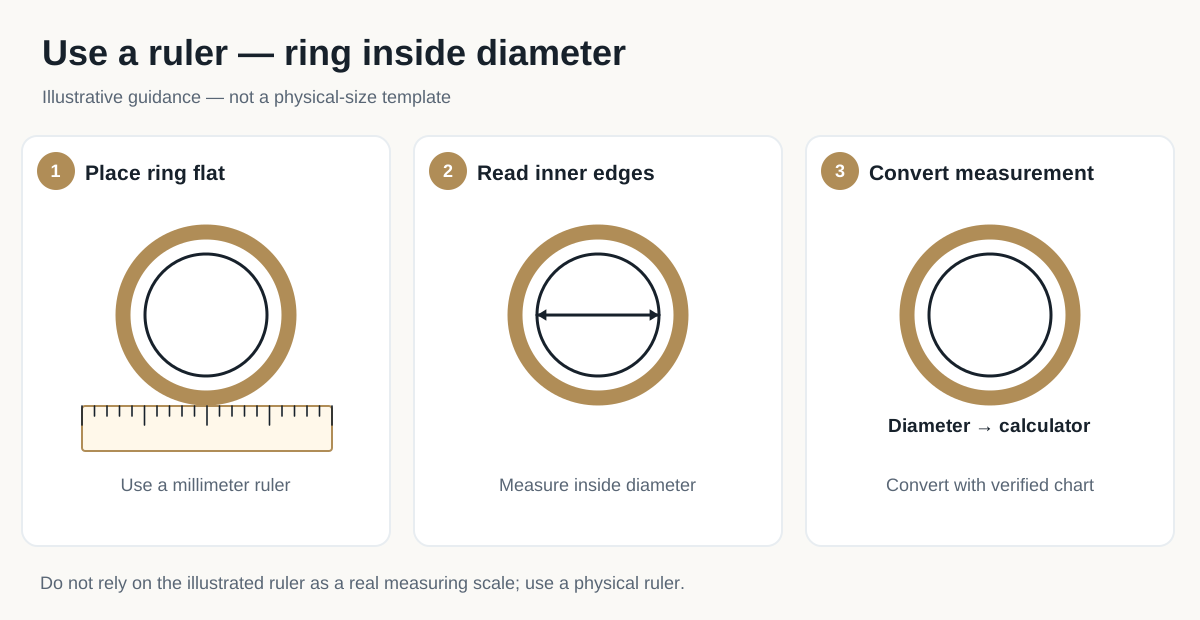
Lay the ring flat on a table. Lay the ruler across it so the ruler's edge passes through the centre of the ring — the widest point of the hole. If the ruler sits off-centre, you are measuring a chord, which is always shorter than the diameter.
Read inside edge to inside edge
Read from the inner edge of the band on one side to the inner edge on the other side — not outer edge to outer edge, which adds twice the band thickness and can be 3–4 mm too large. Note the reading in millimetres.
Mind the zero and the angle
Start from the ruler's zero mark, not from the end of the ruler, which is often worn or rounded. Look straight down at the ruler: reading at an angle (parallax) shifts the apparent position by a millimetre or more on a thick ruler.
Repeat at three angles
Rotate the ring a little and read again, three times in total. A round ring gives the same reading each time; if the readings differ, the ring is slightly oval and the average is the honest number to use.
Convert the diameter
Type the diameter into the calculator below. It gives the circumference (diameter × π) and every system's size from the published table.
Convert your ruler measurement
Related guides
- Online ring sizer
Match the whole circle on screen — more accurate than one ruler line.
- Printable ring sizer
Print circles at 100% and match the ring to them on paper.
- Ring diameter calculator
Convert any inner diameter to circumference and sizes.
- How to measure ring size at home
All the home methods compared, with timing tips.