

Guide
How to measure ring size
Start with what you already have. The best method is the most accurate one available to you — a ring that fits beats a finger measurement, and a finger measurement beats a guess from another finger.
Start with what you already have
You have a ring that fits
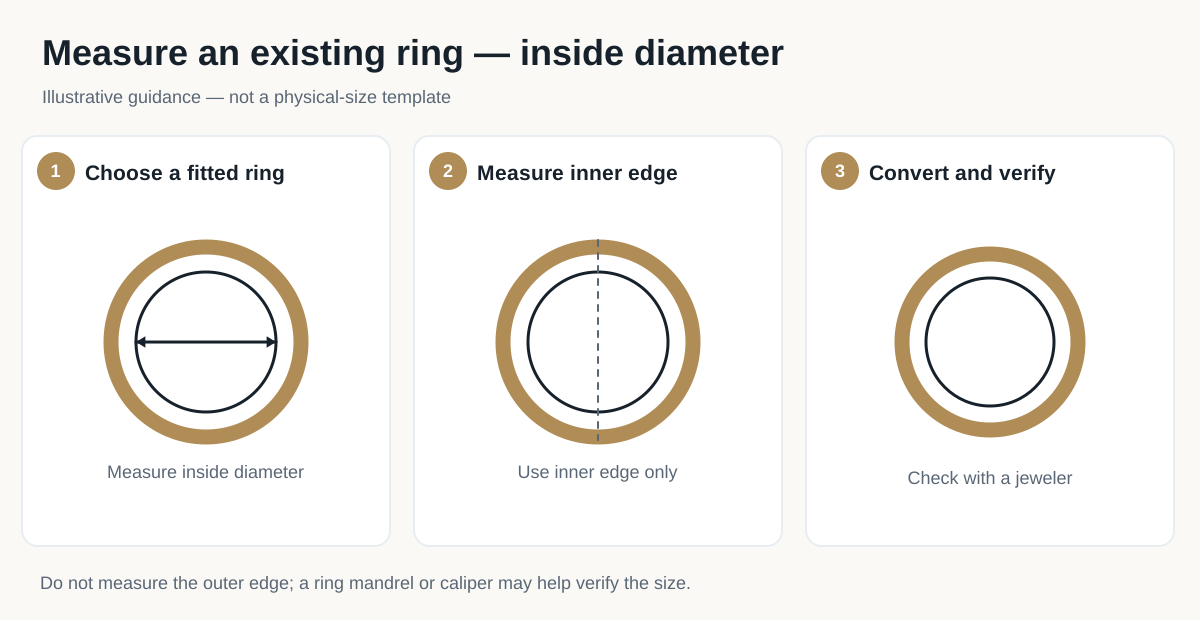
This is the most accurate home starting point, because a ring that already fits is a physical record of the size. Measure it on screen with bank-card calibration, measure its inner diameter with a ruler, or print the circle guide and match it to a printed circle. All three read the same thing: the ring's inside diameter.
You only have the finger
Measure the finger's circumference at its base, where the ring will sit, and convert that number. A flexible tape is best; a non-stretch strip of paper works; string works only if you handle its stretch honestly. Never use a ring from a different finger as a substitute — fingers differ by whole sizes.
You already have a number
A diameter, a circumference, or a size in another system is enough — you do not need to re-measure. Type the number into the calculator or converter and read the equivalents. The one thing to check first is which number you have: a diameter is always under 25 mm, a circumference is always between about 40 and 75 mm.
You have nothing to measure with
If you have no ring, no tape, and no ruler, the honest answer is that a reliable home measurement is not available yet. A paper strip and any ruler — even a printed one from the printable guide — is enough to get started, and a jeweller will size the finger for free in most shops. Guessing a size from a different finger, or from a ring that does not fit, is worse than waiting.
Which method is most accurate at home
| Method | What it measures | Why it ranks here |
|---|---|---|
| Ring on screen / printed circles | Inner diameter of a fitting ring | Reads the ring itself; no finger variation. |
| Ruler on a fitting ring | Inner diameter of a fitting ring | Same quantity, but reading to 0.5 mm by eye is the limit. |
| Flexible tape on the finger | Finger circumference | Direct reading, but finger size moves during the day. |
| Paper strip on the finger | Finger circumference | Same as tape, plus mark and ruler-reading error. |
| String on the finger | Finger circumference | String stretches, so it systematically reads large. |
The ranking is about the method, not about effort: a careful tape measurement beats a careless ring measurement. Whatever method you pick, measure twice, and if the two readings disagree, trust the larger one for comfort — or re-measure at a different time of day.
Common reasons a home measurement is wrong
- Wrong finger or wrong hand. The same finger on the other hand is often a different size. Measure the exact finger, on the exact hand, the ring will be worn on.
- Wrong time of day. Fingers are smallest in the morning and after cold weather, largest in the evening and after salty food. Measure in the evening for a size that still fits later.
- Knuckle larger than the base. If the knuckle is the widest part, the ring must pass it. Measure at the knuckle and at the base, and size for the larger of the two — then check the ring will not spin too freely at the base.
- A scaled print or an uncalibrated screen. A printed guide at anything other than 100%, or a screen sizer used without card calibration, produces a confident-looking wrong answer. Both tools on this site refuse to show a size until their scale is checked.
- Wide bands. A band 6 mm or wider fits tighter than a thin band at the same size, because more of it contacts the finger. For wide bands, size up by about half a US size and confirm with a fitting.
Related guides
- How to measure ring size at home
Full step-by-step methods: ring, paper strip, and screen, with timing tips.
- How to measure a finger for a ring
Finger circumference calculator with strip-method guidance.
- Online ring sizer
Measure a ring you own on screen, calibrated with a bank card.
- Printable ring sizer
Print circles at 100% and match a ring to them on paper.
- Avoiding common sizing mistakes
Twelve repeatable errors that cause most wrong sizes, each with its fix.
- Tool-only page: sizer + calculator
The screen sizer and calculator without the homepage content.
- Ring size calculator
Convert a diameter, circumference, or known size to every system.
- International ring size chart
The full reference table behind every tool on this site.