

Method
Measure ring size with a tape measure
A flexible sewing tape, wrapped around the finger and read in millimetres, is the best finger-only method at home. It reads circumference directly — no marking, no second ruler step, and no stretch if the tape is the right kind.
What you need
A flexible tape
A soft sewing tape, the kind that rolls up. It must bend around the finger without resisting. A metal builder's tape does not count: it is too stiff to wrap, and its hook adds millimetres you cannot see.
Millimetres on the tape
Read the millimetre side, not the inch side. A half-size step is about 1.3 mm of circumference, so a reading to the nearest millimetre is the minimum that is useful — whole centimetres are not.
The right finger, in the evening
The exact finger, on the exact hand, measured in the evening when the finger is at its largest. A morning reading is the classic way to buy a ring that will not go on at night.
Step by step
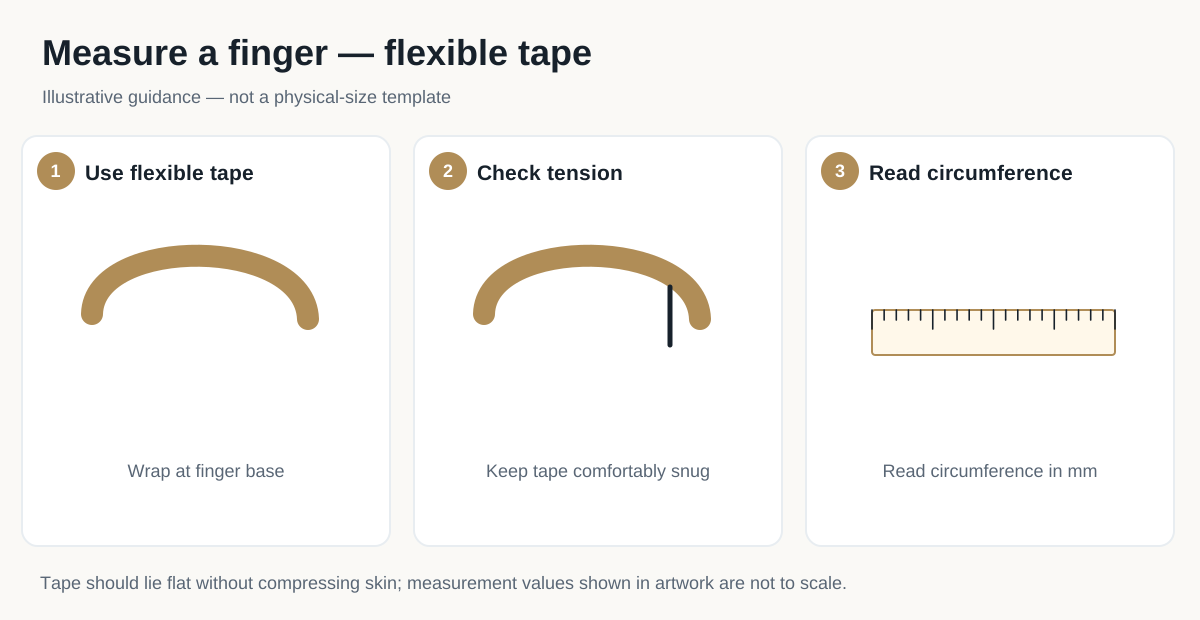
Wrap at the base of the finger
Wrap the tape around the base of the finger, where the ring will sit — not over the knuckle, unless the knuckle is wider than the base (see below). Keep the tape flat against the skin, not twisted.
Snug, not tight
Pull until the tape touches all the way around with no gap, then stop. It should feel like a ring that fits, not like a tourniquet. If the skin bulges either side of the tape, you have pulled too hard and the reading will be too small.
Read where the tape meets itself
Read the number at the point where the end of the tape meets the wrapped tape. That number, in millimetres, is the finger's circumference. Write it down before you unwrap — a second wrap rarely gives the identical number, and you want the first one.
Repeat once, and check the knuckle
Wrap a second time. If the two readings differ by more than 1 mm, wrap a third time and take the middle value. Then wrap once around the knuckle: if the knuckle reading is larger, size for the knuckle, or the ring will not go on at all.
Convert the number
Type the circumference into the calculator below. It matches the nearest chart row and shows every system — no formula, the published table.
Convert your tape measurement
Tape mistakes, specifically
- A stretched-out old tape. Fabric tapes stretch with age and washing. If your tape is years old, check it against a ruler: 100 mm on the tape must be 100 mm on the ruler. A stretched tape reads large, so the ring comes out too big.
- Reading the inch side and converting roughly. 2⅛ inches is not 54 mm — it is 53.98 mm, and that 0.02 mm is fine, but rounding 2.14 inches to 2 inches loses 3.5 mm, which is nearly three half-sizes. Always read the millimetre side.
- Measuring over a bent finger. A bent finger is wider at the joint. Keep the finger straight and relaxed, hand at rest, not clenched and not stretched out stiffly.
- One reading only. Tape readings vary by a millimetre or two between wraps. One reading is a guess with a number attached; two or three readings are a measurement.
Related guides
- How to measure a finger for a ring
Finger circumference calculator with paper-strip guidance.
- Measure ring size with string
The string method, and how to handle its stretch honestly.
- Ring circumference calculator
Convert any circumference number to diameter and sizes.
- International ring size chart
See where your circumference sits in the full table.